

Delivering cellular connectivity is straightforward when a requirement is contained, but as the service expands, so do the challenges. A connectivity offering may start in one market, but growth can quickly mean adding countries, networks, plans, customer segments and distribution channels.
Traditionally, that expansion introduces more technical and commercial work such as new network relationships and provisioning processes. A wholesale eSIM platform changes that equation by creating a single operating model for accessing the connectivity infrastructure required to deliver the service.
Through an API, connectivity becomes something applications and digital services request and manage programmatically, while the wholesale platform handles the network and operational processes required to deliver it.
Why Cellular Connectivity Becomes
More Complex as It Scales
Growth in connectivity is not only about serving more customers. It means supporting a wider geographic footprint, adding new data plans, launching through new digital channels, or making connectivity part of another product altogether.
Each new dimension creates dependencies behind the customer experience. A new market may require additional network access; a new offering may need different provisioning and charging rules; a new channel may need connectivity information to flow into another app, CRM, or support environment.
That makes the real scaling challenge keeping the connectivity layer consistent while everything built on top of it changes. If every expansion requires a new integration or operating process, complexity scales in tandem.
From Network-by-Network Integration
to a Common Connectivity Layer
A wholesale eSIM platform creates a layer between the provider delivering connectivity and the individual networks and systems involved in providing it. Rather than exposing network processes to every application, customer journey or operational team, the platform provides a consistent way to access and manage connectivity across them.
For Telna, that layer is built on a global connectivity footprint spanning 200+ countries and more than 800 network agreements, giving customers a single route to connectivity across markets.
An eSIM profile is only one part of that model. The wider platform brings together network access, profile management, provisioning, lifecycle management, usage information, billing and operational tools. Those capabilities then connect with existing applications and operational systems through an API.
The API is the interface; the platform is the infrastructure behind it. An app does not need to understand every network process involved in preparing an eSIM service. But it does need a reliable way to request the service and receive information back.
What Happens When Connectivity
Becomes Programmable?
Let’s look at a travel platform that wants to offer connectivity after a customer books an international trip. The customer chooses a data plan inside the travel app. Behind that action, the app requests the appropriate eSIM and plan through the API, while the connectivity platform handles the processes required to provision the service.
The relationship does not end at activation. Usage and service information flows back into the customer experience, a top-up or renewal triggers another API request, and service status feeds support and operational workflows. What looks like a single feature inside the app is connected to a much larger connectivity environment behind the scenes.
Telna put this model into practice with a travel and telecommunications provider, using our API-driven connectivity platform to integrate global eSIM services with the company’s existing systems. This partnership saw the provider achieve more than 1 million app downloads and become a leading provider in the eSIM provider in the travel industry.
The same principle applies beyond travel. A fintech could add connectivity to a premium subscription. An operator could introduce a new digital proposition across several markets. A super app could make data plans available alongside other services. The customer-facing experience changes without requiring the connectivity offering to be rebuilt each time.
This is where the API-based model becomes more important than any individual API function. It creates a repeatable way for other systems to interact with connectivity as the offering evolves.
One Connectivity Layer, Different Business Models
The same platform model can support very different starting points. Established operators may be looking to extend the infrastructure and propositions they already have. Digital-first brands may be introducing connectivity into a customer journey for the first time.
Extending Existing Connectivity Operations
For MNOs and MVNOs who have strong connectivity infrastructure and customer relationships already in place, the value lies in amplifying what already works. A wholesale eSIM platform gives them a single foundation for entering new markets, launching new products and reaching new digital channels.
An operator can connect eSIM and plan management with existing apps, CRM systems and operational environments, while using automation and centralized visibility to support growth. This way, adding another market or product doesn’t mean creating an entirely separate operating model.
For established operators looking to scale while retaining visibility and control, Telna Connect provides complete end-to-end connectivity management, bringing these capabilities into a single environment that can support growth across markets and services.
Making Connectivity Part
of Another Digital Experience
For digital-first brands and super apps, the same architecture solves a different problem. Connectivity does not need to become a separate destination or customer journey. It can become another service available inside the digital experience the brand already owns.
Customers can choose and manage connectivity inside an existing app, website or booking platform, remaining within a familiar brand experience while the connectivity platform handles the necessary telecom processes.
Connect Flex provides a turnkey route to launch for digital-first brands and super apps without building the connectivity infrastructure from scratch, using API integration to connect the platform’s capabilities with the digital journey around them.
The API Is Only as Valuable
as the Platform Behind It
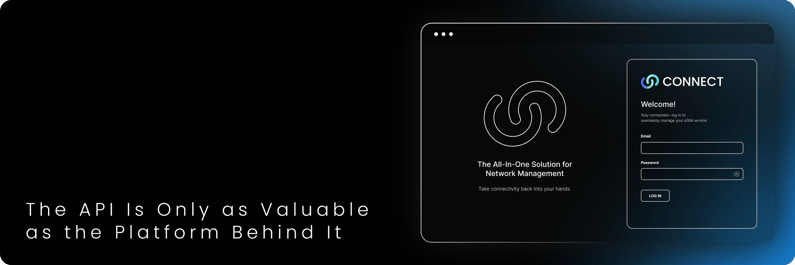
An API makes connectivity easier for another system to manage, but the API alone is not the connectivity service. Its value depends on what sits behind it: the wholesale platform that brings together core capabilities, flexibility, and global reach needed to deliver connectivity at scale.
As a global connectivity partner, Telna brings these elements together through a managed wholesale eSIM platform, providing a single technical and commercial model for accessing and managing connectivity across markets. This gives MNOs, MVNOs, digital-first brands and super apps the foundation to build, embed and scale connectivity services without having to manage the underlying complexity market by market.
Talk to Telna about building a more scalable operating model for API-based connectivity.
Subscribe to our Newsletter! Stay at the forefront of the latest trends in connectivity services, 5G, and digital transformation.