

According to Apple: What’s next has already arrived.
The hardware has evolved. Is your eSIM infrastructure ready for what’s next?
eSIM is becoming the norm
Apple’s latest iPhone announcements make one thing increasingly clear: eSIM is becoming the norm.
With the introduction of the iPhone 18 Pro, 18 Pro Max, and the new Duo, Apple continues the shift away from physical SIM cards. The Duo, Apple’s first foldable iPhone, is eSIM-only worldwide, while the iPhone 18 Pro and Pro Max are eSIM-only in 12 countries, including the US, Canada, and Japan.
The bigger story isn’t simply what’s inside the phone. It’s what eSIM makes possible beyond it.
As eSIM adoption grows, connectivity can become a more flexible, digital experience, one that can be purchased, activated, and managed across devices, markets, brands, and channels.
For operators and brands, that raises a bigger question: Is your eSIM infrastructure ready for what’s coming next?
eSIM is changing connectivity, globally.
Without a physical SIM to insert, replace, or ship, the connection process can occur entirely through a digital journey. Customers can purchase a plan, receive an eSIM, activate service, and manage their connectivity without ever handling a physical card.
Think about it this way:
-
Airlines can offer eSIM during bookings
-
Travel platforms can add connectivity with trips.
-
Fintechs can include data with premium accounts.
-
Brands can build connectivity into existing apps or services.
The future of connectivity can be sold and delivered just like that. But these experiences require more than simply offering eSIM.
It requires:
-
Infrastructure that can support multiple networks
-
Products
-
Partners
-
Customer journeys that don’t require a new tech model for each use case
Build once. Scale across channels.
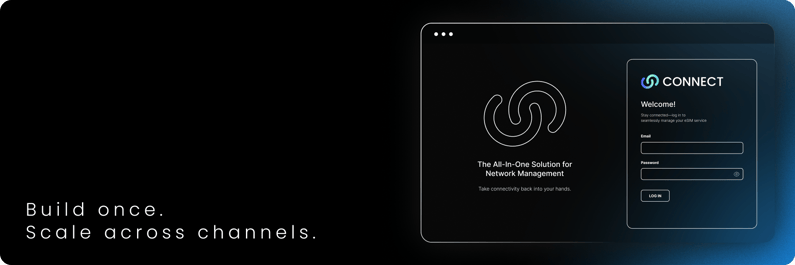
This is where a managed wholesale eSIM platform for global roaming can make a difference.
Rather than building separate systems for every partner or market, a shared infrastructure layer can centralize core capabilities such as eSIM provisioning, activation, plan management, billing, usage, and lifecycle management.
APIs then make that connectivity accessible wherever the customer experience lives. This is particularly important as businesses explore global eSIM API capabilities and multi-network connectivity. The goal isn't to force every partner into the same experience. It’s to give them the flexibility to create their own while relying on the same underlying connectivity foundation.
The result is a more scalable model: a single connectivity foundation configured for different channels, partners, products, and markets.
The infrastructure has to evolve, too

The evolution of eSIM raises an important consideration for anyone evaluating connectivity infrastructure: how does it perform as the number of networks, partners, devices, and use cases grows?
Why do wholesale eSIM platforms stall at scale? Often, complexity grows alongside every new integration, market, or partnership. A more flexible approach separates the connectivity infrastructure from the customer experience built on top of it.
That allows operators to expand distribution without having to rebuild their connectivity model each time. It also gives brands access to connectivity through APIs, white-label experiences, and embedded journeys that fit naturally into the services they already provide.
The hardware will keep evolving. So will the ways people buy and use connectivity. The opportunity is to ensure the underlying infrastructure can evolve just as quickly.
From new iPhones to new digital experiences, eSIM is becoming the norm. The question is no longer whether your business can support eSIM; it’s whether your infrastructure is ready to do more with it.
Explore how you can do more with our eSIM, which powers IoT and roaming devices with global data.
Subscribe to our Newsletter! Stay at the forefront of the latest trends in connectivity services, 5G, and digital transformation.