
.jpg?width=300&name=Header%20Image%20(8).jpg)
A traveler lands in a new country; here’s what happens.
Their device connects automatically, their bank authenticates them silently, and their travel app updates their loyalty status and local recommendations without them opening it. The traveler didn’t need to plan any of that manually. Three technologies made it happen: eSIM provisioned the connection remotely, APIs linked the services, AI managed the logic.
AI, eSIM, and APIs are often discussed as separate innovations for telecoms, but their real value emerges when they operate together. Combined, they turn connectivity into a programmable service, leading to faster launches, personalized customer experiences, and more opportunities to differentiate commercially.
We are just at the start of this shift, but the first bricks are already laid, from network APIs to investments in AI-led automation. Here’s what’s happening for each technology individually, and what it means for operators.
AI is Making Telecom Operations Smarter Where It Counts
Far EasTone Telecom (FET) offers a clear picture of what AI looks like when it is working. They have embedded agentic AI across 60% of Network Operations Center (NOC) activities; that’s about 10,500 operational tasks per month. FET focused on activities that once required manual investigation, and which can now be resolved in seconds: incident summaries, automated ticket closures, alarm correlation, and root cause analysis.
FET is not an outlier. NVIDIA’s 2026 survey of telecoms professionals found that 90% saw AI boost sales while driving down costs.
The proactive nature of agentic AI means network intelligence can connect directly to customer journeys. This leads to a reduction in field dispatches, improves provisioning accuracy, and frees up teams to focus on work that actually needs them.
What this means for operators
In telecom, the use cases with the clearest ROI can include:
-
Network health and predictive operations
-
Fraud detection
-
Onboarding optimization
-
Provisioning workflows
-
Churn risk prediction
In other words, AI works best when applied to specific, high-volume workflows where the data is rich and the cost of error is measurable. That is where operators are seeing real returns.
eSIM Makes Connectivity a Digital Product
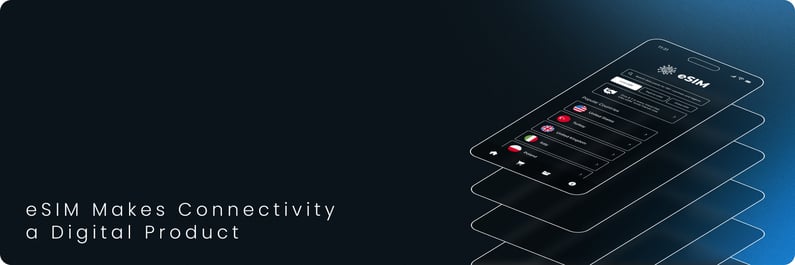
The "eSIM replaces the physical SIM card" framing is accurate, but it undersells what is actually happening. The more useful way to think about it is: eSIM turns connectivity activation into a software event. That matters because it makes connectivity easier to distribute, to embed into digital journeys, and to adapt across markets and devices.
The eSIM ecosystem has moved fast. Kaleido Intelligence found that 30% of smartphones shipped in 2024 contained eSIM hardware, with 365+ MNOs across 123 countries supporting eSIM for consumer use cases by Q1 2025.
But the most important development may be what sits underneath the provisioning layer: the entitlement server. It enables silent SIM authentication, replacing SMS one-time passwords that are vulnerable to SIM-swap fraud, interception, and man-in-the-middle attacks. Instead of asking users to enter a code, the network authenticates them cryptographically, in the background, using keys stored on the SIM. The user sees nothing. The operator reduces a major fraud vector, removes friction from the login flow, and opens the door to identity-led services that can also be monetized.
What this means for operators
eSIM lowers the barrier for launching and scaling connectivity services but it also lowers the barriers for fintechs, travel brands, retailers and other non-telecoms players to launch mobile services. For these brands, connectivity becomes a customer retention tool, creating new partnerships and distribution opportunities for operators who are ready for them.
Operators competing in this landscape need a platform that can handle the full eSIM lifecycle. Telna's managed eSIM infrastructure is built to handle exactly that operational complexity, so operators can focus on the commercial layer rather than the technical one.
APIs Turn Network Capabilities Into Scalable Services
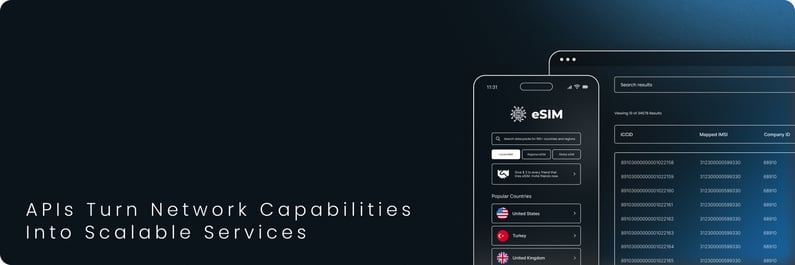
An API acts as a bridge. It gives another system, app, or partner access to a specific network capability through a set of rules or protocols, without needing to understand the underlying infrastructure.
Here are some examples of this:
-
Banks and online retailers are using SIM-swap and number verification APIs to detect fraud in real time.
-
Enterprises are using quality-on-demand APIs to request enhanced network performance for video, payments, and mission-critical operations.
-
UK operators launched commercial age verification APIs in 2025, within weeks of the Online Safety Act coming into force, processing hundreds of thousands of API calls per month.
These initiatives are largely made possible by the GSMA’s Open Gateway project, which promotes the standardization of network APIs and facilitates their deployment. It now counts 86 operator groups representing over 300 networks and 80% of global mobile connections. More than 60 channel partners, from hyperscalers to aggregators to CPaaS providers, are commercializing network APIs alongside them. What began with eight CAMARA APIs in 2023 has grown into a commercially active portfolio deployed across 65 markets. In three short years, the ecosystem has flourished.
What this means for operators
Standardized network APIs mean operators can participate in digital ecosystems (fintech, enterprise mobility, identity, IoT, etc) without building custom integrations for every partner. The infrastructure is there. The opportunity is packaging it, making it accessible, and getting to market at the speed developers and enterprises expect.
That's the model Telna has been built around from the start. A single, standardized API gives customers access to every mobile network in the world, with Telna handling the network relationships and infrastructure that underscore it.
(Watch to learn how Telna is scaling travel eSIM with open APIs)
Together, AI, eSIM, and APIs Create Programmable Connectivity
Each technology covered so far can solve real problems independently, but when they run together, they produce something none of them can deliver alone.
Consider what a connected service requires, for example:
-
A subscriber needs to be authenticated.
-
Their device needs to connect to the right network.
-
The service they are accessing needs to verify their identity without friction.
-
A relevant offer or adjustment needs to reach them at the right moment.
Done manually, each of those steps involves a human, a delay, or a point of failure. Done through integrated AI, eSIM, and API infrastructure, the entire sequence becomes automatic.
That is where the choice of connectivity partner matters. Telna's platform is built for exactly this operating model: a managed eSIM infrastructure, a global APN, and an API layer that abstracts network complexity and makes connectivity programmable for operators,MVNOs, and the enterprises and brands they serve.
The telecom opportunity is about what becomes possible when the three technologies work as a system. Operators that integrate AI, eSIM, and APIs into a coherent platform will move faster, serve better, and unlock commercial models that simply weren't available before.
Subscribe to our Newsletter! Stay at the forefront of the latest trends in connectivity services, 5G, and digital transformation.