
.jpg?width=300&name=Header%20Image%20(7).jpg)
An MVNO closes a strong quarter: subscriber numbers are up, activation volumes are healthy and travel demand is solid. It’s all looking good until the finance team runs the margin report. And that’s where the numbers don’t match the story.
This isn’t an unusual scenario; it’s increasingly a default one. Carrier-imposed wholesale rate fluctuations have upped MVNO operating costs by 20%, compressing margins even as the overall market grows. As GSMA Intelligence put it in their analysis of 2,100+MVNOs worldwide: "Getting in is one part of the story; staying in is a completely different one."
This is where operations start to matter.
For a long time, many MVNOs could live with a patchwork setup: one system for onboarding, another for billing, another for connectivity, and plenty of manual reconciliation. But customer expectations have changed. They anticipate the same experience as they would from an Apple product or an Uber order. They want instant access to connectivity and control a few taps away, with low onboarding friction.
eSIM plays a key role in helping MVNOs realize better margins and faster launches, but for MVNOs to see true success, modernizing their legacy infrastructure must come first. This means adopting APIs and modular systems to make integration more intelligent. Otherwise, it’s like trying to bolt a rocket engine to a horse-drawn carriage.
Why the Connectivity Layer is Key

Modernization for MVNOs is often framed as simply a product shift from SIM to eSIM, but it’s actually a shift from static infrastructure to programmable connectivity.
This distinction matters, because when the connectivity layer becomes API-driven and centrally orchestrated, it changes three fundamental things:
1. Cost stops being passive
In traditional wholesale agreements, volatility is absorbed by MVNOs. Programmable connectivity flips that. MVNOs can influence traffic behavior, optimize routing, and control exposure across networks. Cost becomes something you steer.
2.The activation-to-revenue gap closes
Manual provisioning and legacy SIM logistics complicated the onboarding experience, sometimes across days. Digital activation embeds onboarding directly into the purchase experience. Revenue capture starts to align with customer intent and working capital pressure reduces.
3.Growth doesn’t need more people
Every new subscriber on a legacy stack means more exception handling, more dashboards, more headcount. Centralized lifecycle management and automation change the equation. You scale the subscriber base without scaling the operations team. The ceiling gets higher. The floor stays put.
“MVNOs have always been very good at running a lightweight organization”, says James Gray of Graystone Strategy. Treating connectivity the same way is the logical next move.
The Results MVNOs Typically See After Modernizing
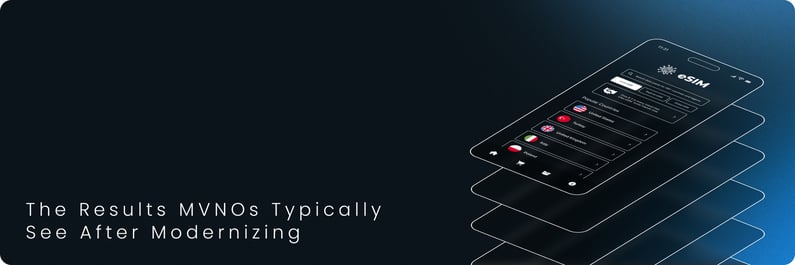
While no two MVNO deployments are identical, modernization tends to improve the same operational areas: launch speed, provisioning efficiency, cost visibility, and customer activation experience.
How Telna Connect Enables These Outcomes
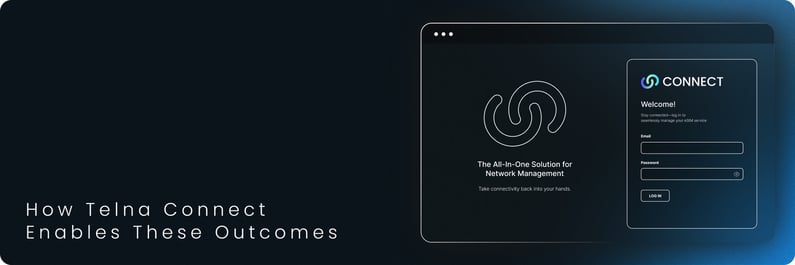
Telna Connect is built around the idea that MVNOs should not have to manage multiple disconnected layers just to launch and run a modern service.
In practical terms, that delivers four things:
1. Simpler launches
Telna’s API-first approach and integration model are designed to fit into existing environments, so MVNOs can reduce the burden of piecing together separate systems. Weeks to market rather than quarters.
2. Less manual effort
Centralized eSIM lifecycle management means teams handle service status, profiles, packages, and inventory in one place. The operational overhead that scales with manual processes stops growing.
3. Better control
Real-time oversight and self-service control across network management gives MVNOs visibility into the parts of the operation that directly affect service quality and cost. Wholesale exposure becomes something you manage, not something you absorb.
4. Room to grow
With broad network reach and a single agreement model, MVNOs can expand coverage and launch new offers more easily without rebuilding the stack each time.
Behind that capability sits an infrastructure built over a decade, including:
-
One integration: 350+ direct roaming agreements, 35+ MNO IMSI partnerships, and redundant access to 800+ networks in 190+ countries.
-
A full GSMA member and FCC-licensed MNO, built on a cloud-native core
-
Trusted by 200+ MVNOs worldwide.
The Decision Most MVNOs Are Already Facing
Three questions worth sitting with:
-
Could your connectivity model be working harder for your margins?
-
Is there an operational cost that better automation could eliminate?
-
What would it mean to enter a new market in weeks rather than quarters?
For most MVNOs, the answer to these questions lies in the connectivity layer. Modern MVNOs win by consolidating control into a single platform built for the way connectivity is actually bought, activated, and consumed today.
That’s exactly why we’ve built Telna Connect: to give MVNOs a foundation built for digital-first distribution.
Our commitment to supporting MVNOs goes even one step further. Telna's Travel eSIM Growth Venture backs early and growth-stage travel eSIM MVNOs with minority investment, strategic support, and direct access to Telna's global infrastructure. You keep control. Telna provides the runway.
Whether you’re early-stage or early to modernize, we’re just one click away from supporting you. Get in touch today to find out more.
Subscribe to our Newsletter! Stay at the forefront of the latest trends in connectivity services, 5G, and digital transformation.